When Apocalypto arrived in December 2006, it looked like an unlikely Hollywood product: a big-budget, R-rated action film set in a pre-Columbian Mesoamerican jungle, with no major stars and dialogue entirely in Yucatec Maya. Nearly two decades later, it remains one of the most unusual studio-backed films of its era. This article discusses the film's plot and ending.
From The Passion to the jungle
After the enormous success of The Passion of the Christ (2004), which was performed in Aramaic and Latin, Mel Gibson had the leverage to try another ambitious, subtitled project. He co-wrote the script with Farhad Safinia and produced it through his company, Icon Productions, with a budget reported at around $40 million.
Gibson framed the story as a survival thriller set against a civilization in decline. The film opens with a line often attributed to historian Will Durant, suggesting great civilizations are destroyed from within before conquest from outside. The plot follows Jaguar Paw, a young hunter whose village is raided, and who escapes sacrifice in a decaying Maya city and races home through the forest to save his family. In structure it is closer to a chase movie than a historical epic.
A cast without stars
Rather than hire famous actors, the production held casting searches across Mexico and North America, looking for performers of Indigenous descent. Rudy Youngblood, who played Jaguar Paw, came to the film with little acting experience and a background as a Native American dancer. Raoul Trujillo, Dalia Hernández, Gerardo Taracena and Morris Birdyellowhead filled out a cast that audiences largely didn't know.
The cast learned their lines in Yucatec Maya, still spoken by many people today, with the help of language coaches. Many performers delivered the dialogue phonetically, and the film's heavily physical performances help carry the story across the language barrier.
Shooting in Veracruz
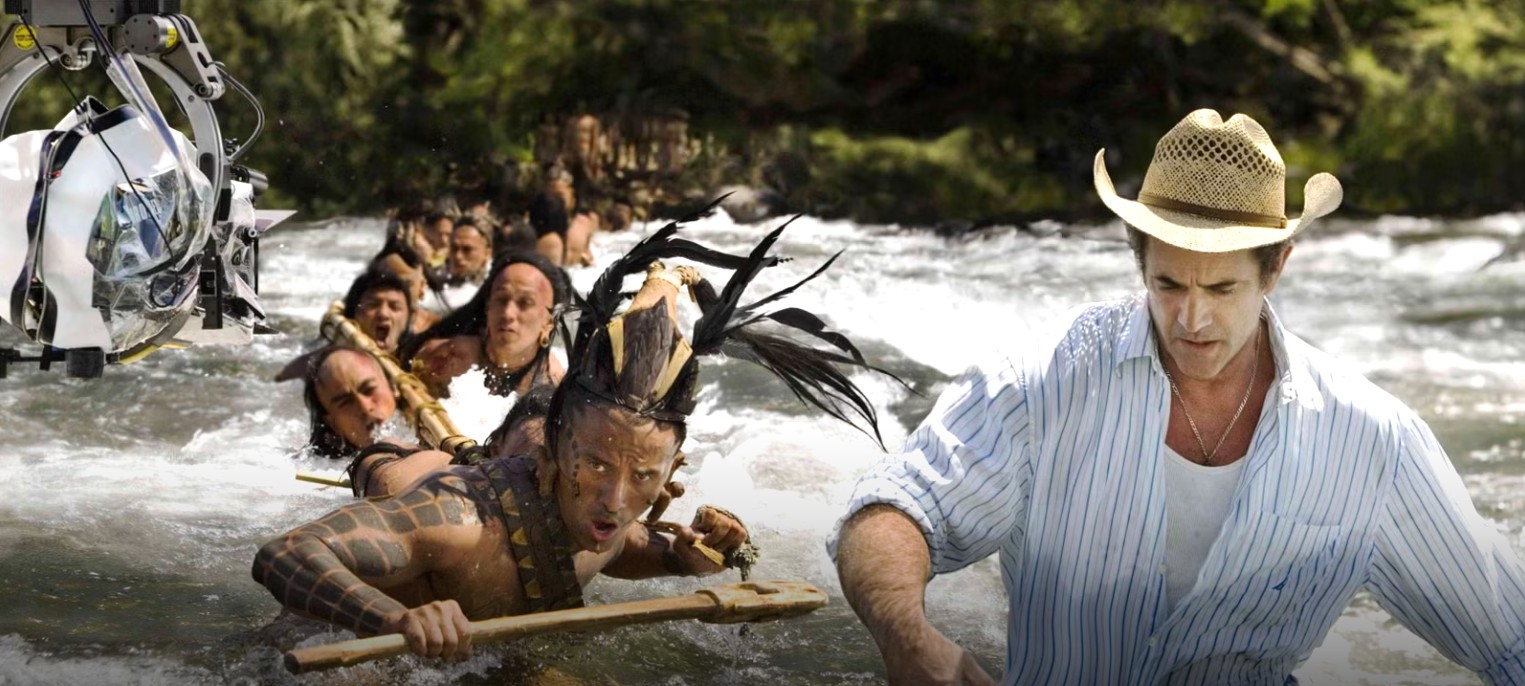
Principal photography took place in the state of Veracruz, Mexico, in tropical jungle terrain. The production built large sets, including a Maya city, and conditions were demanding: heat, humidity, water, mud, and long physical sequences. Production designer Thomas E. Sanders led the construction of the city, which blended physical sets with digital extension work to create the sense of a sprawling urban center.
Cinematographer Dean Semler shot the film on Panavision's Genesis digital camera, one of the earliest major studio features to do so. The digital format suited the film's style, with its mobile handheld camerawork, dim jungle interiors, and long running sequences, and it let the crew shoot in difficult locations with greater flexibility than film stock would have allowed.
Action built on practical stunts
Apocalypto is remembered for its extended action, particularly the second half's pursuit through the forest. Sequences include a leap off a waterfall, a trap-filled jungle chase, a quicksand pit, and a jaguar attack. The filmmakers relied heavily on stunt work, prosthetics, and makeup, and the film's makeup and sound work earned it Academy Award nominations for Best Makeup, Best Sound Editing, and Best Sound Mixing.
James Horner's score added to the atmosphere, mixing orchestral writing with Indigenous-style instruments and percussion to give the film a distinctive sonic texture.
What made it unique
Language and casting. An entire studio-backed action film in a Maya language, with Indigenous and largely unknown performers, was almost unheard of in Hollywood.
Structure. It strips a historical setting down to a primal chase, favoring momentum and visual storytelling over exposition.
Technology. Its early embrace of high-end digital cinematography foreshadowed where the industry was heading.
Intensity. Its graphic violence and relentless pacing made it a divisive but memorable viewing experience.
Controversy and historical accuracy
The film drew significant criticism from historians and archaeologists. Many pointed out that it blends elements of different Mesoamerican cultures, such as the Aztec-style heart sacrifice, with Maya imagery, and that its portrayal of the Maya as violent and collapsing from within oversimplifies a complex history. The timeline is also compressed, with the arrival of Spanish ships at the end invoking a period well after the classic Maya collapse. Some Indigenous commentators and scholars felt it reinforced stereotypes, while others praised the visibility given to Indigenous actors and languages.
Gibson himself was also in the news. His arrest in the summer of 2006 and the controversy over his remarks cast a shadow over the release, though the film still performed solidly, earning roughly $120 million worldwide.
Legacy
Apocalypto endures as a bold, polarizing piece of filmmaking: visually immersive, technically ambitious, and historically contested. Whether viewed as a thrilling survival story or a flawed portrayal of Maya civilization, it remains a rare example of a major studio backing a film in an Indigenous language, and a striking reminder of how far a director with leverage and a strong vision can push the boundaries of mainstream cinema.